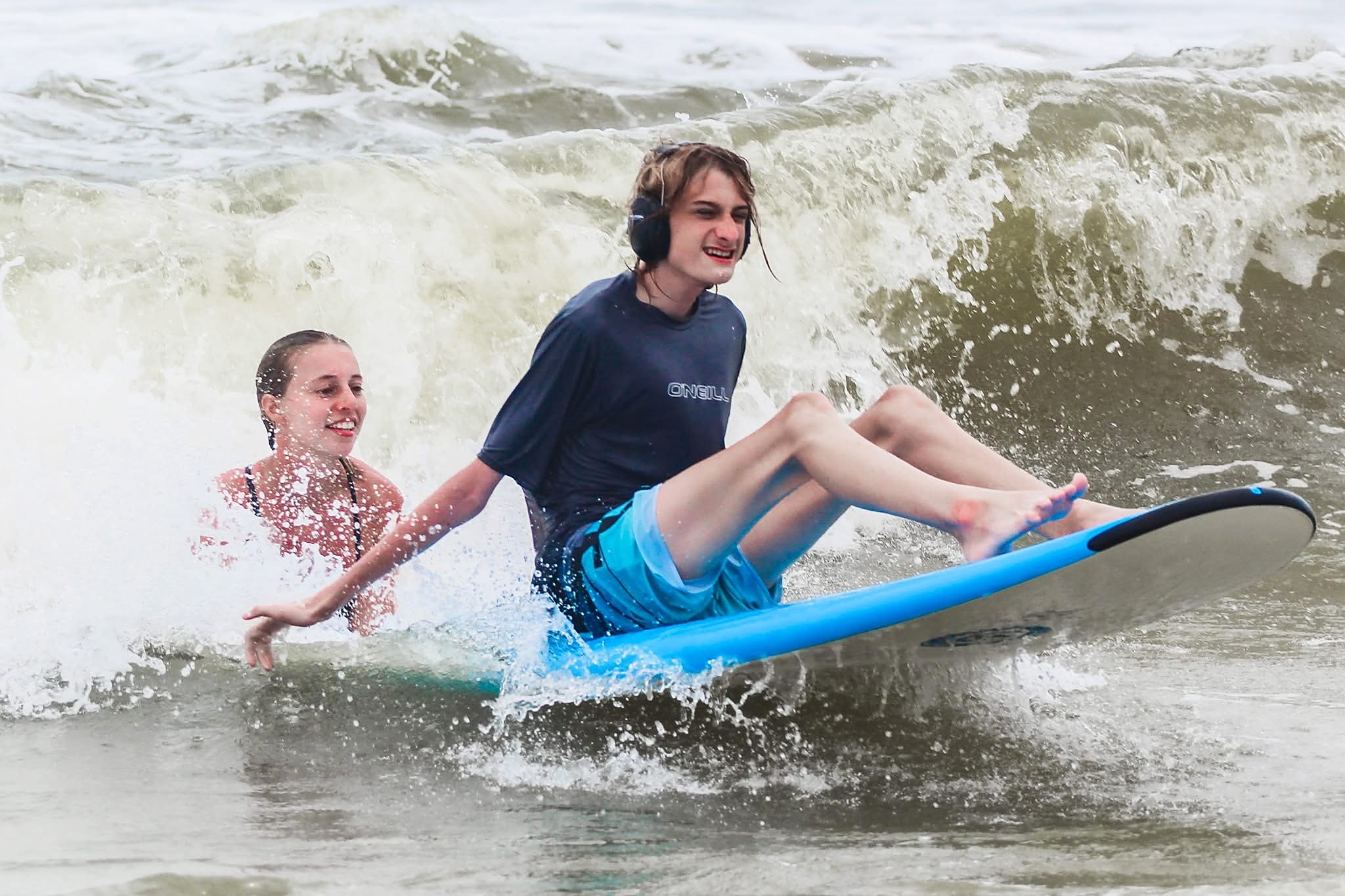
The night before a Surfers for Autism event, the volunteer sheet might show fifty names. In the morning, 250 athletes — the word is Moose Brown’s, and he means it — will be waiting on the sand, a day that takes hundreds of helping hands.
The CEO has learned not to worry.
“After doing it for eighteen years, I know my guys are going to show up,” he says. And they do — hundreds of volunteers, day of, unannounced, filling the beach before the first athlete touches a board.
That faith is the closest thing to a business plan the organization has. Since 2008, Surfers for Autism has run free surf events for children and adults on the autism spectrum across Florida and into Georgia — a couple thousand families a year, across an April-to-October season — and Moose has been there from the start. In the early years he ran everything that happened on the beach itself — the tents, the stations, the boards, moving the equipment — while a husband-and-wife team handled the behind-the-scenes work of food and registration. When they retired, around 2017, he took over the whole operation.
A festival day means 250 athletes on the water between morning and mid-afternoon. It means 800 to 1,200 free meals at lunch. And it means exhibitor tents on the sand — therapists and local services that work with this community, set up for families who often don’t know where else to turn.
Even that doesn’t cover the demand. On some days during the season, the organization runs three events on three different beaches at the same time — more than 300 athletes in a single afternoon — and families still land on a wait list.
Every bit of it is free. That part is non-negotiable, even when his own board pushes back.
“Board members will be like, Moose, tell me something that’s free,” he says. “I’m like, I don’t know.” Every organization charges a registration fee, they remind him. “But I feel so bad doing that to our families.” These families already carry a lifetime of expenses. A registration fee is one more thing.
So there isn’t one.
Athletes, Not Participants
Listen to Moose talk for any length of time and you notice he never says participants.
He says athletes.
“I don’t like labels, so to speak,” he says. “But I do like the label athlete, because they’re coming out and they’re trying. They’re giving us all that they have. They’re working through their fear to be able to get out there on the water on the board.”
It’s a respect thing — the same instinct that has him saying “yes, sir” to high schoolers. He wants to give this community the respect it may not get in its day-to-day.
“When you get to learn and know about them, it’s like, oh my God, they’re superheroes. They have such amazing abilities versus disabilities that make you and I question, what’s up with us?”— Moose Brown
The label fits, too. One young man who started with the organization at age four now surfs in other people’s contests in his twenties. Another adult on the spectrum volunteers at events and spends his days off boogie boarding on his own. That’s the quiet power of surfing, Moose points out — it’s an individualized activity. Once you learn it, it’s yours. You can take it anywhere.
Families come to him at the water line and recite the list — everything the professionals have said their child will never do. Doctors, occupational therapists, specialists with what Moose calls “alphabets behind their names” — credentials he’s the first to admit he doesn’t have. He listens, and then he makes the same offer he’s made to family after family:
“Give us an opportunity for thirty minutes in the water with a board and your child, and let’s just show you what they can do.”— Moose Brown, CEO, Surfers for Autism
In that water, he has watched nonverbal children speak for the first time. He has watched their parents break down on the sand. “The joy on these parents’ faces,” he says, “it’s just undescribable.”
For the parents, an event is a rare chance to step back and just watch. Moose asks them to stay on the sand and let the volunteers work. His reasoning: a child who falls off a board looks to a parent and finds panic, but looks to a volunteer and finds an excited face cheering them back up.
“They can probably do a lot more than we’re giving them credit for.”
These families arrive carrying more than beach chairs. Moose sees it every time: “You have families that feel like nobody cares.”
The event is built to be the opposite — what Moose calls a judgment-free zone, where nobody is the different one. Not the athlete. Not the family. “It’s their day. They’re the rock stars.”
A family’s first event means a beach full of strangers. By their second, those strangers are the people who understand exactly what they’re going through, because they’re going through it too.
The People Who Follow
Internally, they joke that the following is like the Grateful Dead — people who drop whatever they’re doing to get in the water with the athletes, event after event, town after town. The Christian Surfers volunteers who work alongside him see it differently. They told him he has a congregation: all ages, all demographics, a church that meets on whatever beach the trailers roll onto.
He’s still getting his head around the congregation part.
There’s the young woman who drives down from Indiana for a Jacksonville Beach event, sleeps in her car at the event site, spends the day in the water, and drives home to go back to work as a nurse.
His Special Forces friend just retired after twenty years — most of them spent in war zones, “seeing the worst of the worst.” Now he follows the tour from event to event and stands in the water “with a smile bigger than anybody that I know.”
The veteran friends he’s recruited come back with the same confession: “You told me you needed help. I didn’t realize how much help I was gonna get. These kids are amazing.”
And there are the pirates.
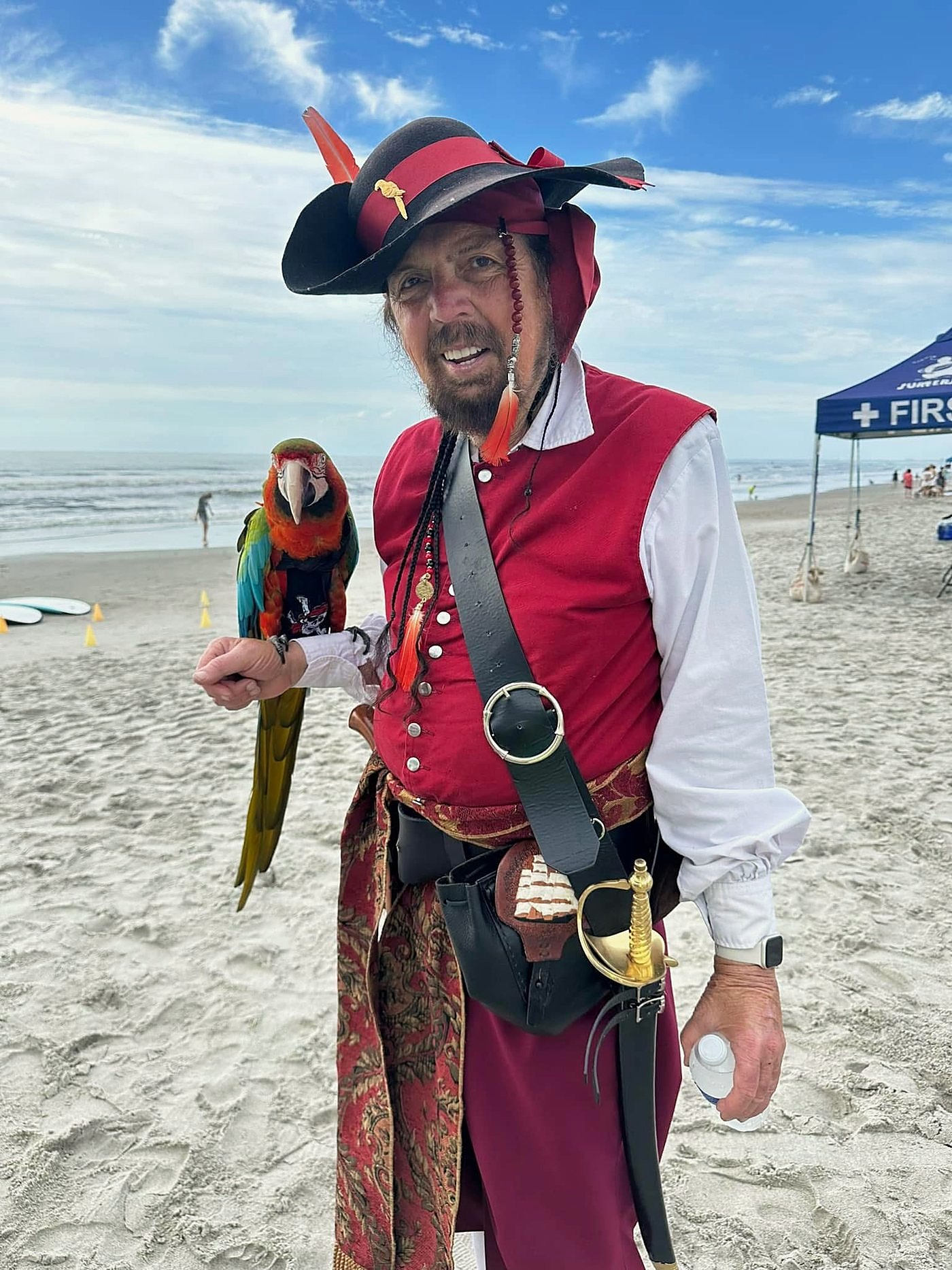
At a Cocoa Beach event one year, a pirate convention happened to be underway at a hotel down the beach. A group wandered over in full costume, asked what was going on, and never really left. The pirate club now travels to events, sits at the water line with costumed mermaids for the kids, and throws fundraisers that help keep it all free for the families.
The tattoo parties are their own phenomenon. After an event, Mark Longenecker — a well-known Cocoa Beach tattoo artist — draws up flash, sheets of ready-to-ink designs, and families and volunteers of age line up for the Surfers for Autism logo and other autism-related pieces. The last party had more than eighty people in line. For some, it was their first and only tattoo.
“How many organizations do you know that have a couple hundred people running around with their logo on them?”
Some volunteers’ lives quietly changed direction — young people who started showing up in high school, or before, and found a career path in it: occupational therapists, physical therapists, registered behavior technicians, behavior analysts. “They weren’t sure what they wanted to do,” Moose says, “but this helped create the path for them.”
His advice to a nervous first-timer is short. You don’t have to be a surfer. Cheer from the sand — the kids feed off the energy. Sharing the stoke, they call it. Not a strong swimmer? Help carry a wheelchair down to the water so an athlete can be part of everything. Serve lunch. Pack trailers.
Just know the athletes set the pace. “Our kids are chargers,” he says — one west coast event, held right after a hurricane had carpeted the beach in shells, went through a hundred Band-Aids and kept right on going.
“Just come with an open heart and let’s go have some fun together. You’re going to see some miracles happening on the beach. We’re changing lives one wave at a time.”— Moose Brown
That day-of faith is his, though — not necessarily his registration team’s, the ones staring at a thin sign-up sheet the night before. So he has one request: “If I could say one thing to our volunteers, please sign up the day before and help my registration team not have a heart attack on me.”
What They Don’t Outgrow
Moose’s road here ran through twenty years as a bail bondsman — one chapter for a serial entrepreneur who also owned a pawn shop, a courier service, and a landscaping company, and worked the car auctions. The bail work showed him how much of what he was dealing with came down to mental health: misdiagnosis, no diagnosis, no community, no support.
Coaching with Special Olympics later — an organization he’s quick to say he means nothing negative about — he watched some of the nonverbal athletes, the harder-to-manage ones, starting to be left out. Those were the ones he connected with most. When a group of friends started doing Surfers for Autism events and his own son could join, it clicked.
“I’ve made a ton of money doing a bunch of different things throughout my lifetime,” he says. “This has been one of the most rewarding jobs that I can have.”
About the rest of it — the part a beach day can’t fix — Moose is just as direct. The diagnosis, he says, attacks the whole family. Marriages strain and break. Single mothers tell him their husbands couldn’t make it anymore. The fathers, when they talk to him, explain it the way they’ve explained it to themselves: “I think it’s better that I just leave them alone and give them the space so I don’t keep disrupting their life.” Moose doesn’t speak about any of it from a distance. The challenges touched his own home as well, shaping both his understanding of autism and his commitment to breaking the stigma.
“I can relate to every bit of those things.”
It’s why he’ll break his back to make one event day run smoothly. “It’s a drop in the bucket of what they’re dealing with on an everyday basis.”
The fear he hears most is about the future. This community does not outgrow autism, and the athletes who started at four are in their twenties now — some still riding with him, some volunteering at the same events they grew up in. Housing for adults with significant needs is, in his word, a crisis — families placing ten-year-olds on waiting lists because there is no real answer yet. His summary of what happened instead, over the years, is blunt.
“As they became adults, their housing became jails.”— Moose Brown
The organization is trying to work with a developer and other partners toward an answer of its own.
That, he says, is the deeper purpose under the beach day — one of his many whys. Unite the communities. Let people meet these athletes while they’re young, so the compassion is already there by the time they’re grown.
It’s also why the organization trains outward. Its chapters — smaller events of about 40 athletes, two Saturday mornings a month, created when COVID shut down the big festivals — double as training grounds. For six years in Martin and St. Lucie counties, local fire departments have worked the events alongside the athletes, learning the community before they meet it on a call.
Now, Moose says, they understand why a young man at an accident scene won’t make eye contact, or might be screaming without an injury. He’s overstimulated, not on drugs. His goal, he says, is to get first responders involved — “to be able to help these communities that they serve.”
He’s watched the science catch up too. “When I first started, we were like beach bums,” he says. Now he points to the Blue Mind research — the growing body of work on what being near water does to heart rate and mood. “There’s a lot of science behind it now.”
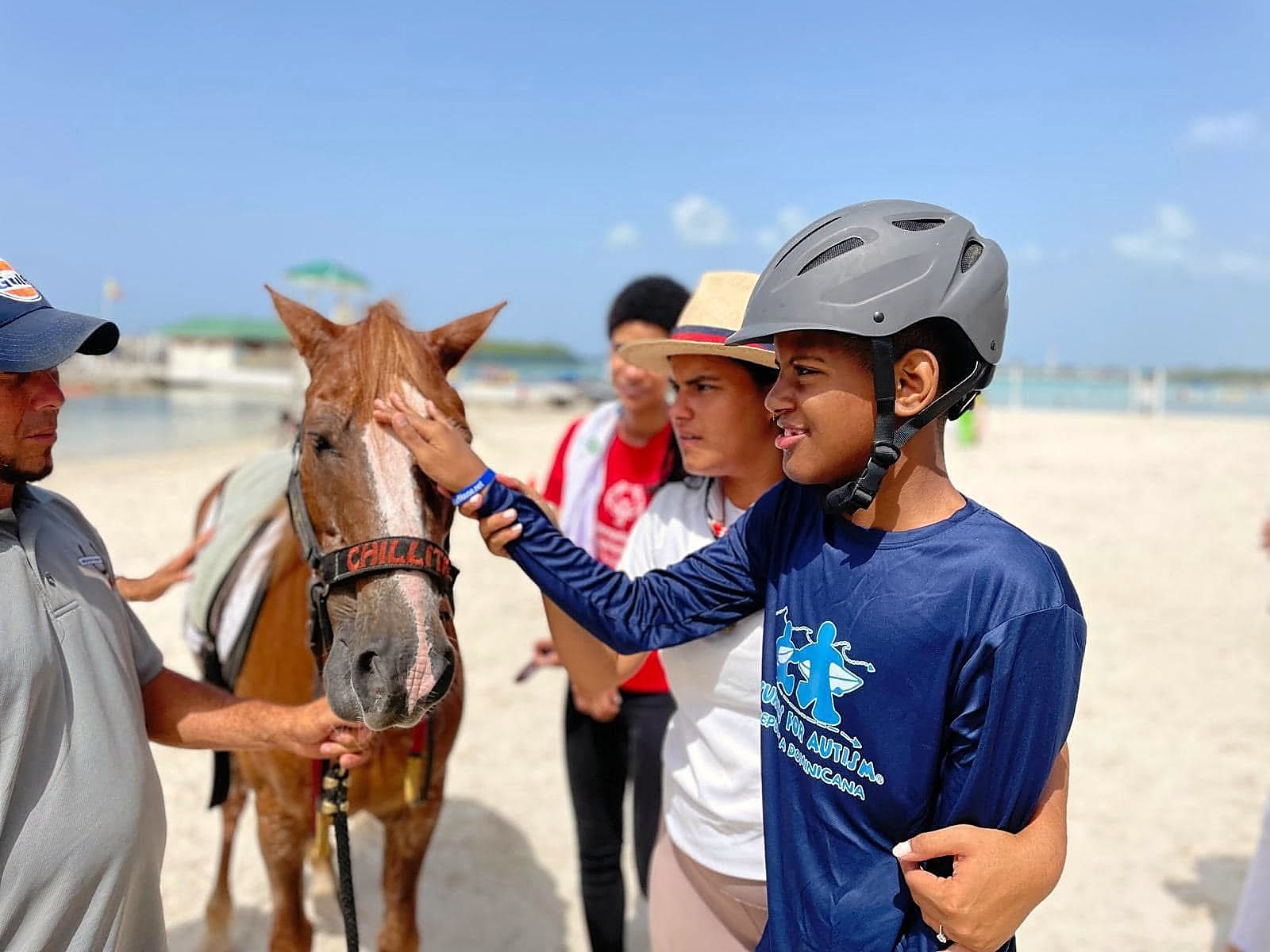
Since 2023, the work has crossed borders — events in the Dominican Republic, where families are decades behind on diagnosis and services, and a generational fear of the water means many families on an island never learned to swim. Teaching lessons there, Moose has had locals insist they could swim right up until they came off the board — “their eyes are this big” — so hungry for the ride they’d claim anything to get it. So the team works in shallow water, on paddle boards, letting the glide do the work. At one event, a boy assumed to be deaf — nonverbal, no eye contact — met Moose’s eyes in the water.
The Quiet Part
Ask Moose about the quietest moment of an event day, and his answer takes the long way around.
He barely sleeps the night before, running the moving parts in his head. From morning until lunch he’s everywhere — registration, merchandise, first aid, exhibitors, the garbage if it needs taking out. “There’s nothing that I won’t do that I would ask someone else to do.” His deal with his crew is that after lunch, he’s in the water — the part of the day he waits all morning for.
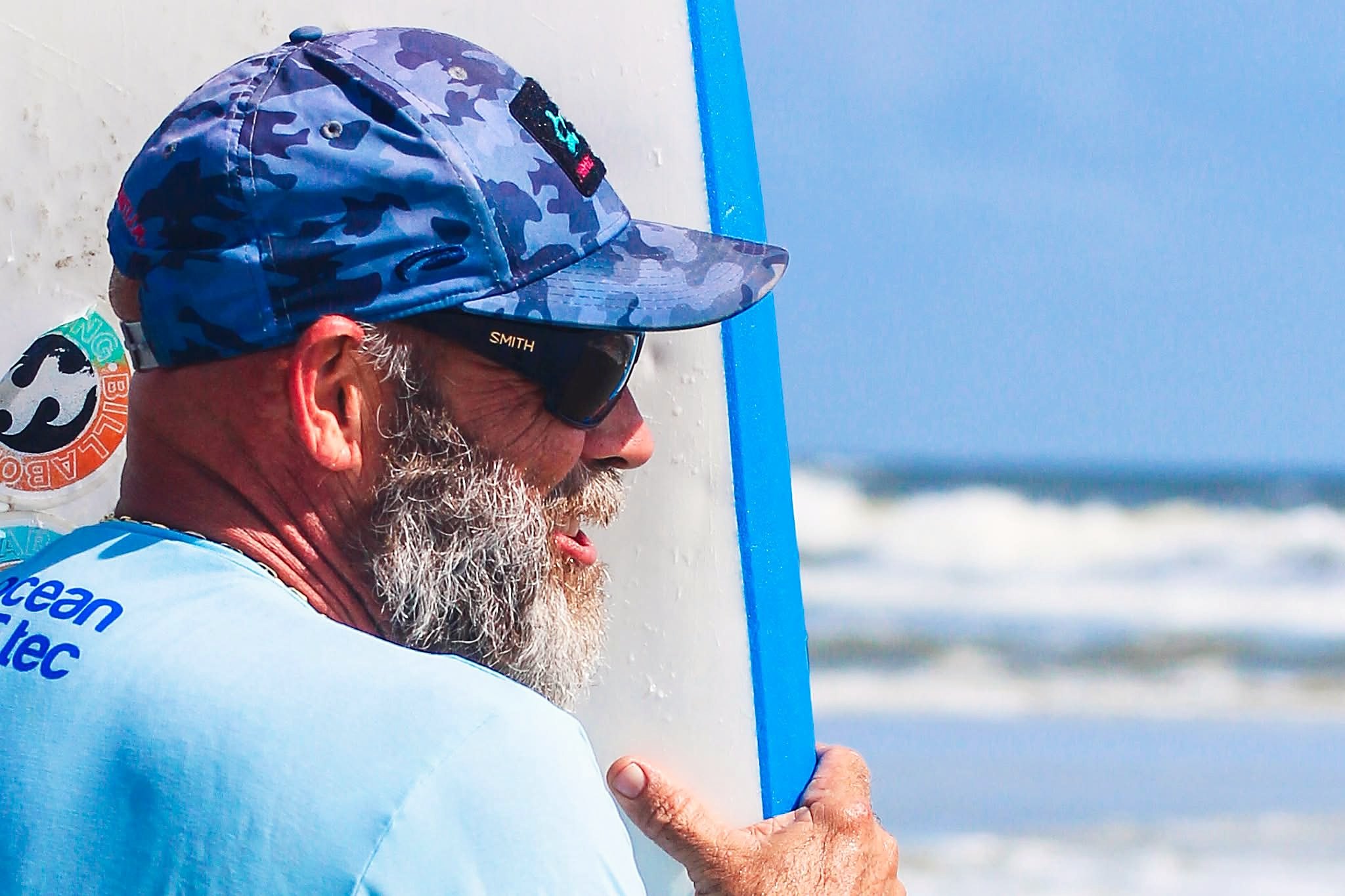
The quiet comes at the end, packing everything back into the trailers.
None of it is cheap. Two trailers, a truck, fuel, insurance, permits that can run thirty pages and thousands of dollars in some towns — $800 in one case just for a medical team to sit on the beach. Restaurants donate what they can; the organization buys the rest. For Jacksonville, that means around forty pizzas, gluten-free options included, because the families taught them to plan for that too.
“We made it through COVID, but the reality of it is we’re still struggling,” he says. “I can tell you how amazing it is, but it’s not because we have all this money. It’s amazing because we have amazing volunteers and amazing families that help us make it happen.”
He credits the sponsors who keep it moving — the car dealerships, Demented Graphics, Mark Longenecker, the pirate club, Woody’s Wash Shack, and the surf shops and restaurants in every town the tour rolls through. Five dollars or five thousand, it all goes back to the program.
Asked what Jacksonville would lose if Surfers for Autism disappeared tomorrow, he doesn’t reach for statistics. He talks about the mother who told him last season that her son doesn’t speak — and that her boy got out of the water and sang. He talks about a whole beach of strangers coming together to see what these athletes can do.
“Every time I do an event, I walk away with what it means to somebody else that I didn’t even realize,” he says.
“It makes me tick. It helps me just as much as it helps them.”— Moose Brown
Here is what Saturday looks like.
When: Saturday, August 8 · morning through mid-afternoon · lunch around noon, athletes back in the water by one
Where: Jacksonville Beach · staging location posted at surfersforautism.org
Who: Free for families · athletes start at age four, with no age cutoff — adults participate too
To participate: Athlete registration filled fast — 250 signed up, roughly 50 families wait-listed · join the wait list at surfersforautism.org
To volunteer: Spots were still open as of this week — the day runs on many hands, and cheering from the sand counts · sign up at surfersforautism.org
Editor’s note: This preview is drawn from a recorded interview with Surfers for Autism CEO Moose Brown, conducted ahead of the Jacksonville Beach event; all quotations are taken verbatim from that recording. Surfers for Autism has run free surf events for children and adults on the autism spectrum since 2008. The Jacksonville Beach event takes place Saturday, August 8. Wait-list registration, volunteer sign-up, and donation options are at surfersforautism.org. First Coast Lineup will photograph the event; a photo essay follows.