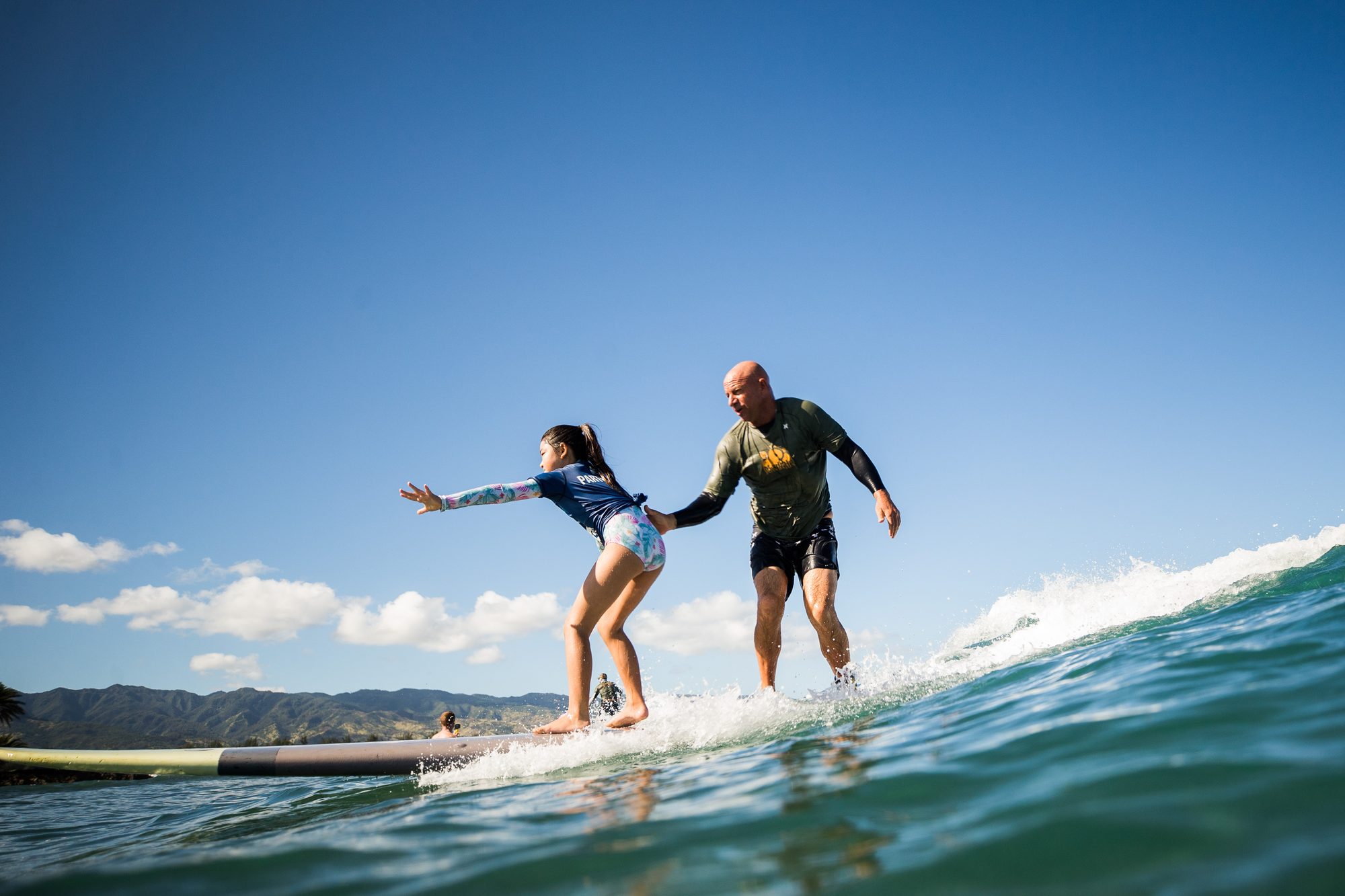
Hans Hagen still has to pack.
It is the night before a 4:30 a.m. drive to the airport, and the executive director of the Mauli Ola Foundation is running through a checklist he describes as long: how to pack, how to ship, how to get everything in the right place at the right time. Tomorrow he meets a crew of professional surfers in New York. From there the tour works down the coast — New Jersey, Virginia, North Carolina — before it reaches Florida and sets up on the sand at the Jacksonville Beach Pier.
“Today’s my last true test of how organized I could really be,” he says, and laughs.
He has been passing that test for a long time. Hagen has been Mauli Ola’s executive director since 2012 and involved since the foundation’s beginning, nearly two decades ago. Before that he was a professional surfer, then a surf journalist, filmmaker, and music supervisor — “the things that kept us in the water and kept me traveling.”
“I have a love affair for the sport of surfing,” he says. “In 2012, I transitioned into this. I just thought it was such a great way to perpetuate surf stoke.”
What he transitioned into is a foundation built on an idea that sounds almost too simple: take kids with cystic fibrosis surfing.
On July 22, Surf Experience Day returns to the First Coast. This stretch of coast raises surfers young — the pier is where they compete, where they learn the lineup, where they figure out who they are in the water. For three hours in July, the same sandbar becomes something else: a place where a kid who has spent a lifetime keeping six feet from everyone gets pushed into their first wave.
Where Biotech Meets the Lineup
Mauli Ola is Hawaiian for “breath of life.” The foundation was started by two brothers, Charlie and James Dunlop — lifelong surfers whose company, Ambry, made genetic tests. The first test they developed was for cystic fibrosis.
Around the same time, the New England Journal of Medicine published research inspired by surfers with cystic fibrosis in Australia whose lungs were doing unusually well. The connection was the ocean itself.
“They just thought, if they’re going to be diagnosing these families with this news, it’d be great to have something to help them,” Hagen says. “Something as simple as taking them surfing. The light went off for them.”
Hagen was a pro surfer in their circle at the time. He volunteered for the first tour and never really left.
“It’s kind of interesting,” he says. “There are very few authentic cross-sections where biotech and science meets surf. And it was really authentic when it all happened.”
What the Ocean Does
Cystic fibrosis is a genetic disease that causes the body to produce thick, sticky mucus, clogging the lungs and making breathing a daily project. Close to 40,000 people in the United States live with it. There is no cure.
Start with what these kids carry into the water. Many are operating at a fraction of full lung function on any given day — 60 percent, sometimes 20. Hagen has seen the whole spectrum, and he has a personal window into it: he has treated asthma with inhalers since he was a child.
“To know that feeling of having a constrictive lung passage, and only have the capacity to get so much air,” he says. “You see the struggle. The struggle’s real.”
Then comes what the ocean does about it. Hagen lays it out in layers.
The first is in the air. When a wave breaks, the mist it throws up is hypertonic saline — the same salt-rich treatment people with cystic fibrosis breathe through a nebulizer at home and in clinic, a routine that takes a serious part of their day.
The second is percussion. Parents of children with CF spend hours performing percussion therapy to loosen the mucus in their lungs. Surfing does some of that work on its own.
“Your board is slapping the water, the wave breaks, you take a wipeout,” Hagen says. “All of that stuff is ultimately helping you expel mucus.”
The third is cardiovascular exercise, which every doctor and physical therapist in a CF patient’s life is pushing for anyway.
The fourth layer is the one Hagen keeps coming back to. Because cystic fibrosis carries the risk of cross-infection, people who have it cannot be within six feet of each other — not in a classroom, not at work, not at a social event. It is a disease that isolates by design.
On the beach, that changes shape. Families register individually, and volunteers sanitize equipment and keep the spacing honest. But the isolation loses its grip.
“All of a sudden, you’re in an open-air salt-air environment, and you go find your spot on the beach, and all of a sudden you don’t feel so alone,” Hagen says.
Then comes the part that is not therapy at all, or is the only therapy that matters, depending on how you look at it.
“The ultimate win is you get to ride a wave. The thing that helps you want to keep living and keep fighting and come back for more.”— Hans Hagen, Executive Director, Mauli Ola Foundation
The proof shows up after the session, and the parents are the ones who report it. “All the parents say their appetite’s back,” Hagen says. “Their love for life, the vitamin D, all the things that happen on a great surf session. It just really helps them and improves their quality of life.”
A Perfect Day at Malibu
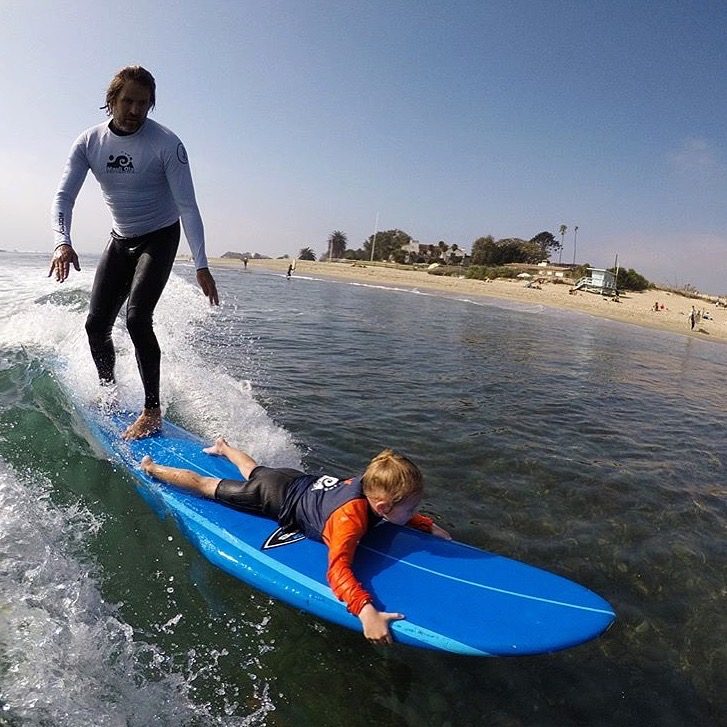
After 18 years of Surf Experience Days — Australia, Santa Cruz, New York, Portugal, and hundreds of beaches between — Hagen describes the archive in his head as a camera roll of smiles. Asked for the one frame that stays with him, he does not reach far.
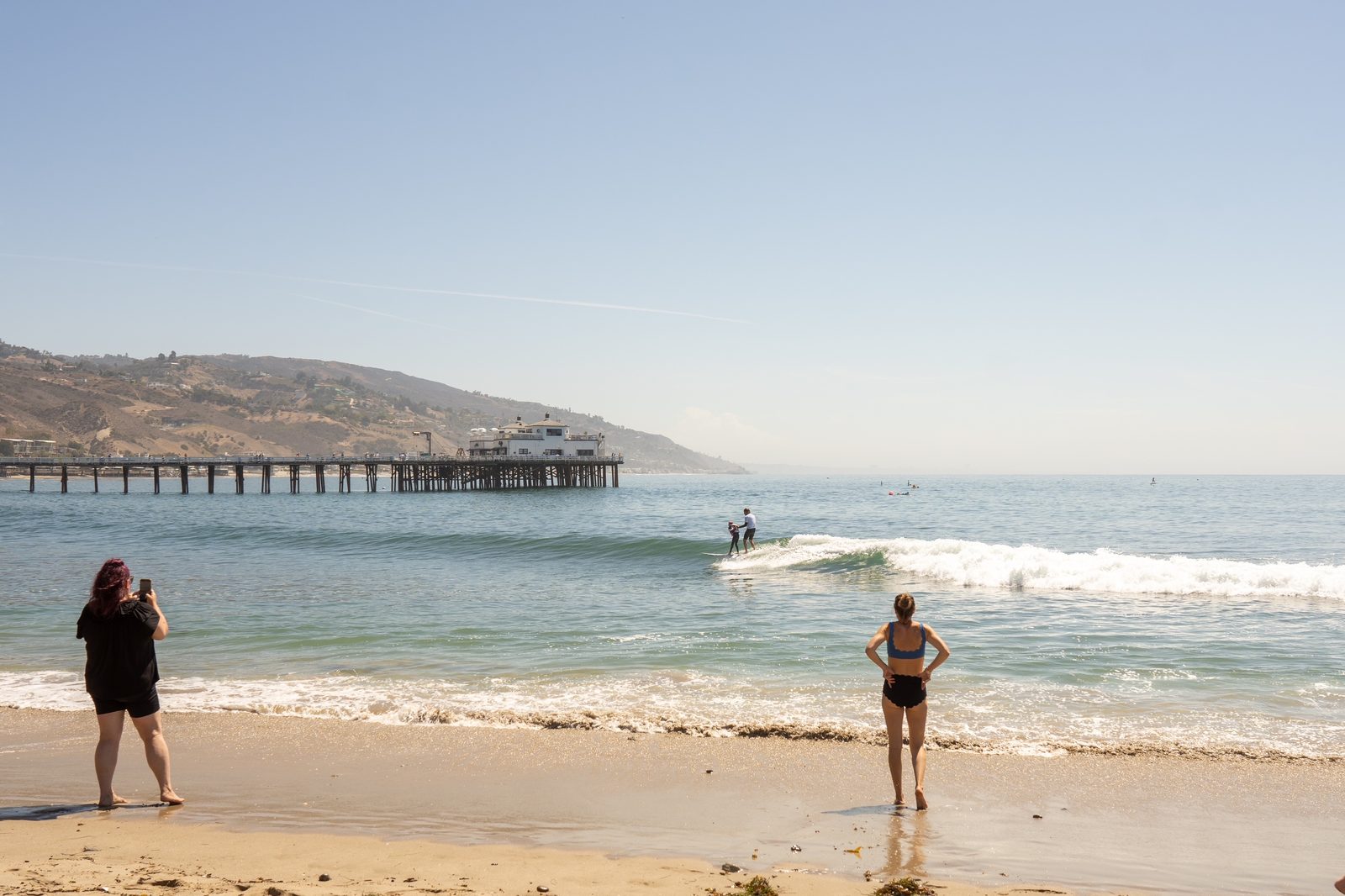
“There was a ride with me and this young girl, Maddie,” he says. “A perfect day at Malibu. It was just sunny and glassy and peeling. I could see the feeling through her vibe and her eyes. There’s some great documentation of a few rides we got that day, and it just seems to translate the feeling I had riding those waves with her.”
The people in the water have changed over the years, and so has the disease. Modulator drugs like Trikafta — a newer class of treatments that target the underlying cause of CF — have transformed the outlook for many patients since Hagen started. He sees people from the program thriving now — starting families, having babies, “stuff that was impossible five, six years ago.”
The pulmonologists who keep the foundation involved in their patients’ lives have started telling Hagen that CF is going to stand for “cure found” one day.
“I would love for the day no one needs Mauli Ola — but I think they’re gonna need us.”— Hans Hagen
That day has not arrived. Many patients do not qualify for the modulators. The spectrum of mutations is wide. And some of what the foundation offers was never in a prescription to begin with. Hagen tells the story of parents who show up at events years after their kids aged out of the program — one family drove six hours just to say their daughter had graduated college and was doing well.
“There’s just a place in the community and in their hearts of a time that they did participate,” he says. “The lights are on for a reason.”
The surf days are also only half the history. For years the foundation ran hospital outreach at a scale that’s hard to picture now — “a legit tour bus full of athletes,” as Hagen puts it, crossing the country to 25 children’s hospitals in a summer, reaching thousands of kids annually, including kids fighting cancer and other illnesses beyond CF. The program scaled back after COVID; these days Hagen handles special requests and individual visits. “We’re not visiting as many hospitals as we used to,” he says. “But we do special cases. We have a long history of doing it.”
Even the pros feel it. Over the years, Mauli Ola has had 15 world champions donate their time, and the traveling roster still draws some of the best surfers alive. Hagen says the effect on them is its own kind of treatment. Big-wave legend Bruce Irons came back to an event recently after a long time away.
“He told me, ‘What a breath of fresh air,’” Hagen says. “These pros have been so caught up in trying to be the best at something, or trying to be on the biggest wave, and then they see this.”
Melissa
Ask about Melissa and something settles in him — he answers like a man describing someone still in the room.
There is one photograph Hagen wanted to make sure came up.
It was taken at a Surf Experience Day in Santa Cruz. In it are Melissa Pappageorgas and her husband, Joey Rodrigues — the year she came back to surf with an oxygen tank.
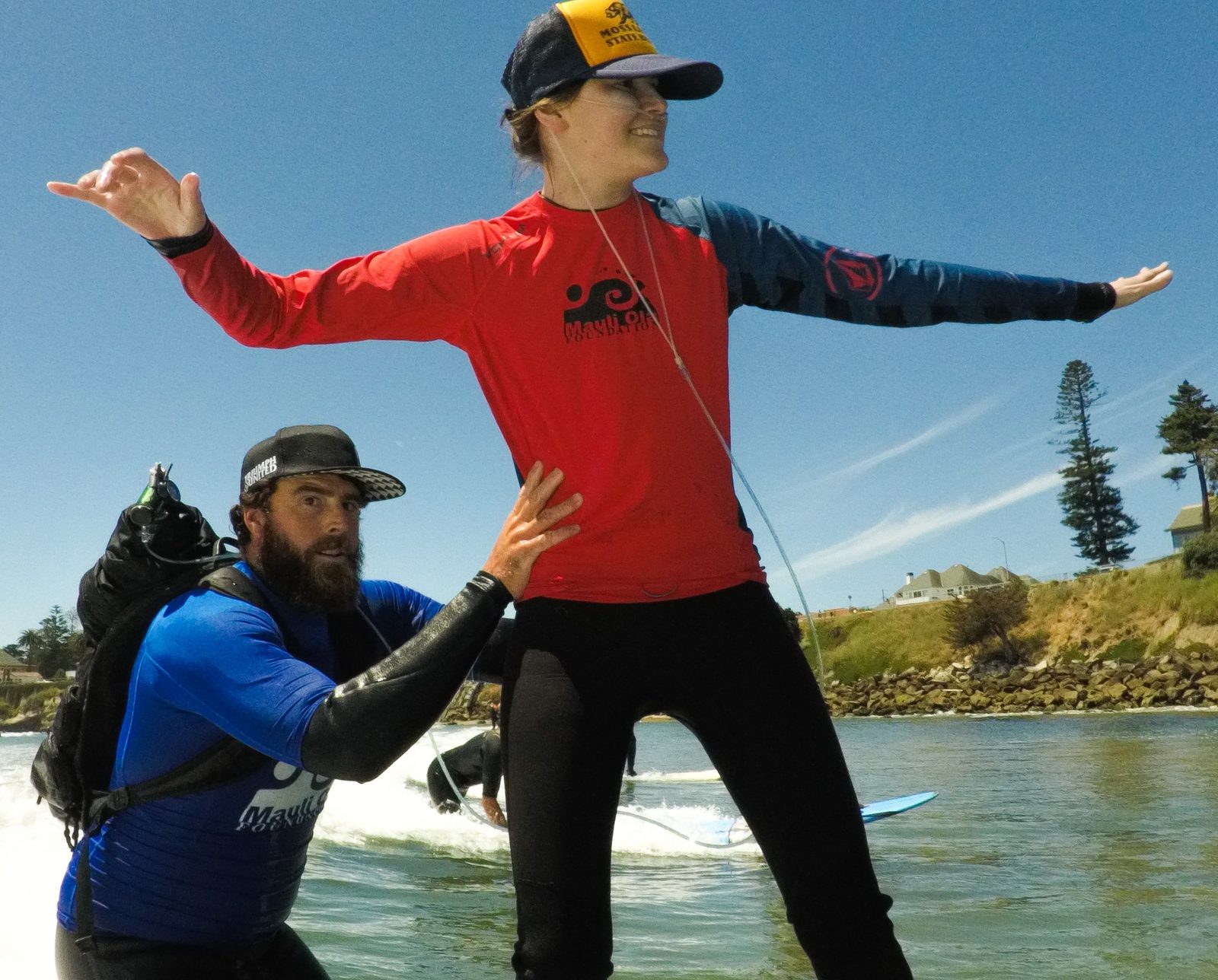
“It’s an amazing shot,” Hagen says. “Just the resilience to keep on going. It’s what got her out and back again.”
Getting her out took a community — a Santa Cruz community. Shaping legend Bob Pearson of Pearson Arrow built the couple a custom 14-foot tandem board that could carry three: Melissa, Joey, and the roughly 20-pound oxygen tank Joey wore on his back so she could breathe while she surfed. O’Neill built the rig that carried it — a modified impact vest with a slanted pocket — and cut Melissa a wetsuit padded for her feeding tube.
“She just never wanted to lose that feeling of riding a wave.”— Hans Hagen, on Melissa Pappageorgas
Melissa came to her first Surf Experience Day at around 19, a USC student who was not raised a surfer and never expected to become one. Her case of cystic fibrosis was severe — diagnosed later in life, and eventually requiring a double lung transplant. She kept coming back anyway, and married a surfer.
The year Mauli Ola won Surfer Poll’s humanitarian award, the foundation brought Melissa and her father to Hawaii to surf and spend the week with the crew. That is where she became the person who taught Hagen the most about the disease he had already spent years working around — walking him through the nebulizer, the percussion vest, the pills, the day-to-day.
“She was very smart, very funny, very open,” he says. “She walked me through all of it. She wasn’t holding anything back.”
“She was highly educated. She could have done a lot with her life. And she did.”
Melissa spent her final years making a documentary about her life, Paddle Out, directed by Sebi Lee — a project nine years in the making, made with her family fully behind it.
“It came out exactly who she is,” Hagen says. “I’m really proud of that.”
Melissa has since passed. Her presence has not.
“Every time I’m complaining about an ailment surfing — because I’m 54 now — I think, Melissa did it,” Hagen says.
Paddle Out has screened at a handful of festivals and one private showing, and Lee is exploring more screenings while the team pursues a wider release. Might one of those land on the First Coast? Hagen didn’t hesitate: “I hope so.” Told that a surf community this close-knit would show up for it, he went further. “A hundred percent.”
July 22 at the Pier
Here is what the day looks like.
When: Wednesday, July 22 · 10 a.m.–1 p.m.
Where: North side of the Jacksonville Beach Pier
To participate: Doctor’s referral required · Register and sign the release form at the event page
To volunteer: Sign up at mauliola.org/pages/volunteer · Donations at mauliola.org
Families arriving will see the foundation’s blue and yellow tent and a registration table. There are gifts — a tour t-shirt, a hat, tote bags, towels, snacks, and water — plus music, boards, and event rash guards, which double as a way to tell who’s who in the water. In keeping with cystic fibrosis protocols, each family finds its own spot on the beach rather than gathering at the tent.
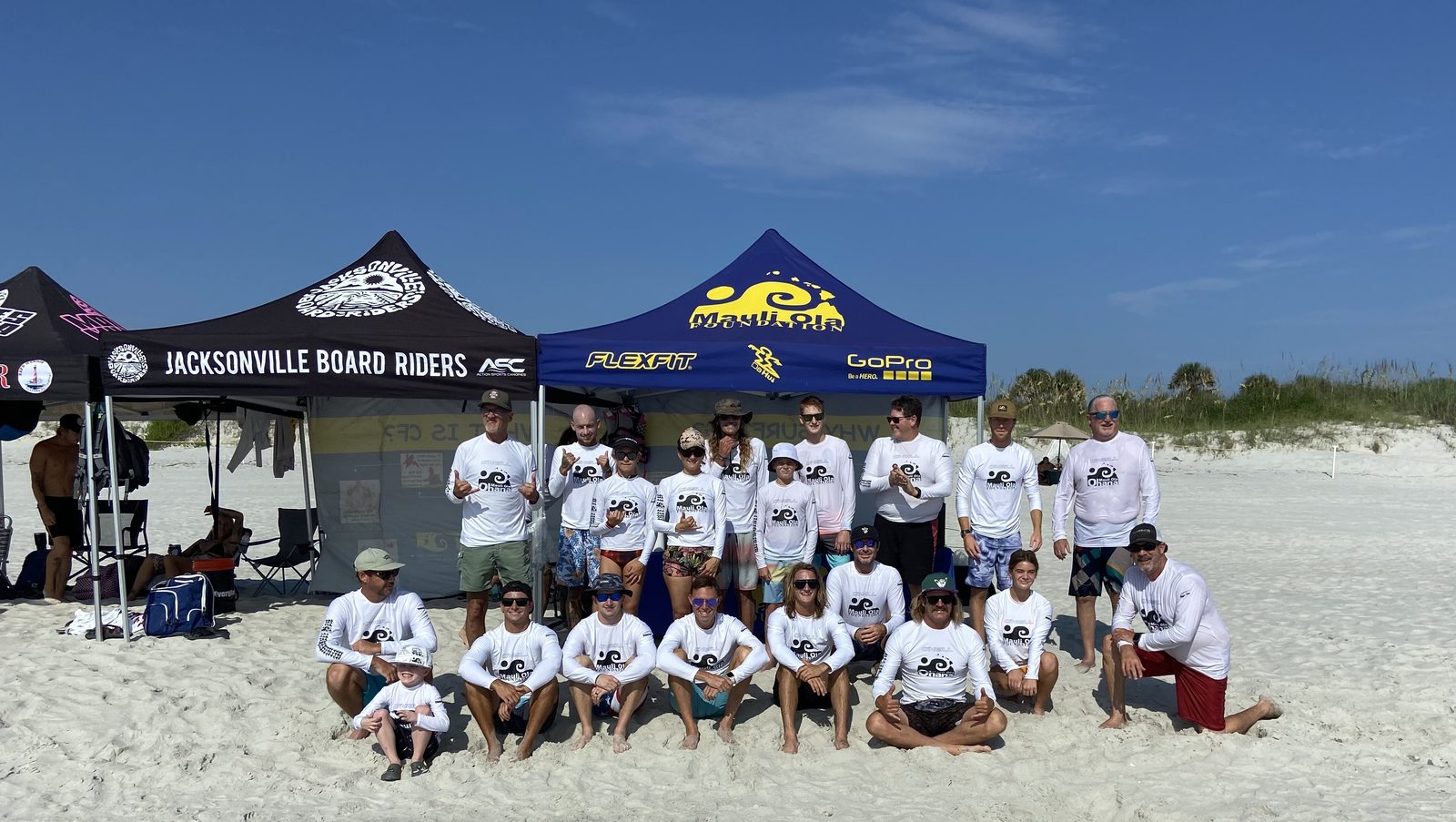
Then the pairing begins. Hagen briefs every instructor on cystic fibrosis and one rule above all: once you are with a family, you stay with that family. Because each patient carries a specific gene and mutation, every session is one-on-one, start to finish.
“That’s where the magic happens,” Hagen says.
The traveling crew includes professional surfers Peter Mel, Anthony Rufo, and Dante Madrigal, joined by local volunteers. The local side of the day belongs to the Motes family and their outfit, Motes Militia — the event’s local host and sponsor. Hagen reached out about four years ago with an opportunity: supply the surfboards when Mauli Ola came to Jacksonville.
“It was a no-brainer,” says Josh Motes, who organizes the local stop. “Such an incredible cause — to be blessed with an opportunity to help out has been a gift.”
Three generations of Motes work the event together — Josh, his father Jason, and his grandfather John “J.D.” Motes. “Working with my dad and grandfather, doing what we love, is nothing short of a blessing,” he says. “We love this city, we love the ocean, and we love the community.”
The why, he keeps short: “Surfing gave us everything. We just want to share it.”
The job on the 22nd, as he describes it, sounds less like surf instruction than like Hagen’s fourth layer. “It’s really about making them feel comfortable in their own skin,” Motes says. “Giving them the confidence in the water that will hopefully carry over into all aspects of their lives — while also keeping it super fun.”
And for the local surfer on the fence about volunteering, he has the closing argument: “If you want to feel good about yourself while also making others feel good about themselves, then come down and help out. Simple as that. Something as simple as riding one wave could change everything for these kids. Who wouldn’t want to be a part of that?”
“Something as simple as riding one wave could change everything for these kids. Who wouldn’t want to be a part of that?”— Josh Motes
Volunteer sign-up runs through the foundation’s website. If the date doesn’t work, the other door stays open. “Donations help. Always needed,” Hagen says. “There’s no end of the work you could do.”
Fourteen years into a job he never imagined for himself, he does not talk about the work like a burden.
“It’s definitely not for the money, I’ll tell you that,” he says. “It’s a good balance of all the things I love. Being wholeheartedly passionate about surfing, it’s really nice to do something that contributes — for those in need. My journey with Mauli Ola has been really tangible. I could feel the results.”
Then he has to go. The checklist is long, the flight is early, and the tour ends on our sand.
Editor’s note: The Mauli Ola Foundation is a 501(c)(3) charitable organization founded nearly two decades ago to promote awareness of genetic disease and support for patients. Its Surf Experience Days pair professional surf instructors one-on-one with participants who have cystic fibrosis. Registration for the Jacksonville event is at mauliola.org/pages/sed-jacksonville-fl; volunteer sign-up and donation options are at mauliola.org. The Jacksonville Surf Experience Day takes place July 22, 10 a.m.–1 p.m., north side of the Jacksonville Beach Pier.