Brad Davis was nervous about the waves.
This was the problem: he had Nicholas Edelman, the CEO of Aventuur, and Ace Buchan, a 16-year Championship Tour veteran, following him to Mayport. Davis, a Jacksonville engineer and a partner in the project, was the local — the one responsible for showing them what First Coast surfing actually is. They’d gotten coffee in Atlantic Beach. He was watching Surfline. He’d checked the Pier cam. “I’m like, oh no, this is so bad,” he says.
Then the little caravan turned in at Hanna Park, home of the Poles — through the gates, under the Spanish moss, down the divided road to the lot, up the wooden boardwalk through the oaks and palmettos. And the ocean, unhelpful all morning, decided to cooperate.
“God just blessed us with waves, and they lost it,” Davis says of Edelman and Buchan that day. “And they’re like, this is what we want it to feel like.”
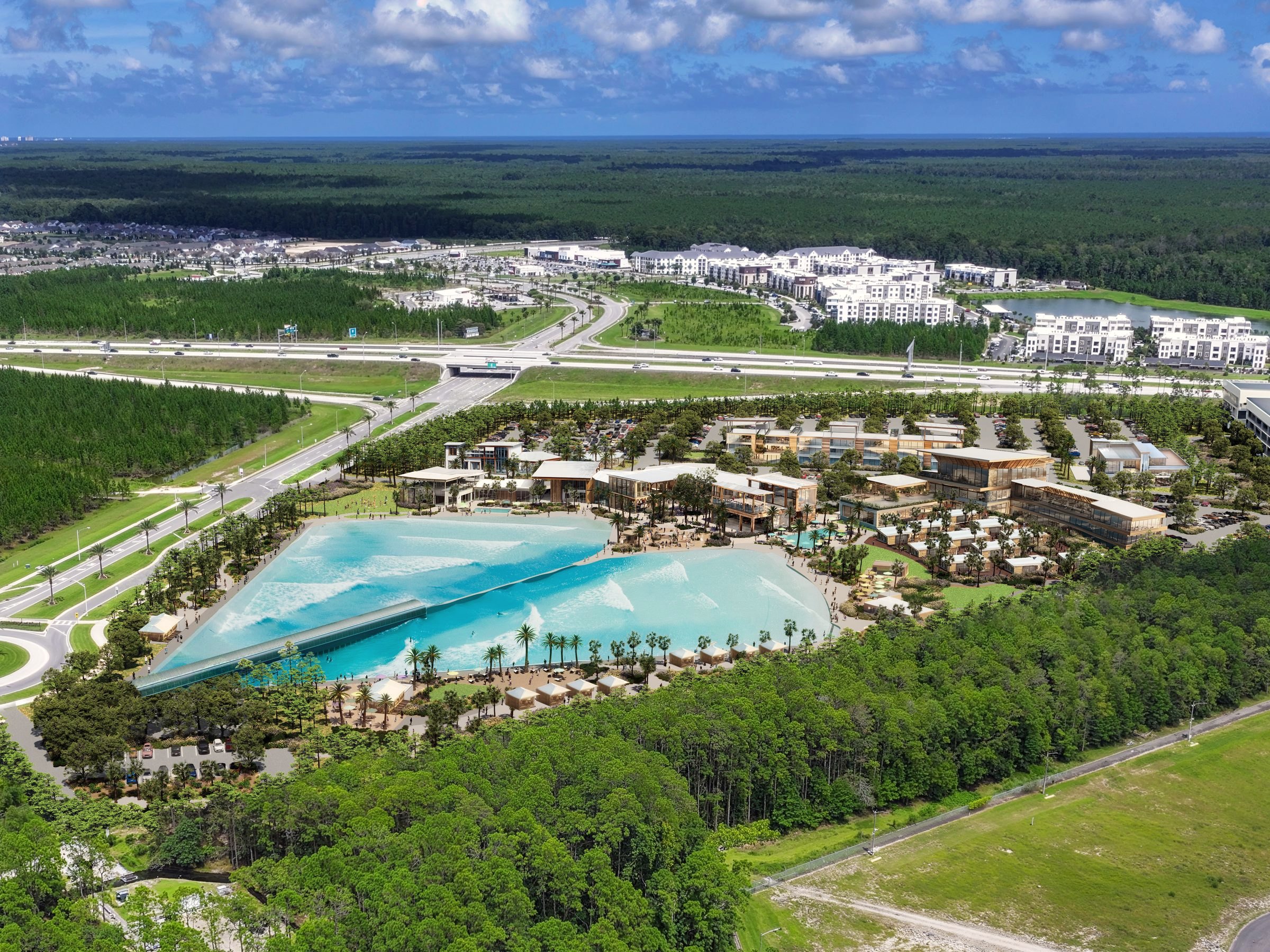
That sentence is now, more or less, a design requirement. The people building the Jacksonville Surf Park — a Wavegarden Cove lagoon planned for eTown, which Aventuur says will be the largest of its kind in the United States when it opens — are trying to engineer the walk down to the Poles. The Spanish moss will be landscaping. The boardwalk will be hardscape. If it gets built, the waves, for the first time in North Florida history, will be guaranteed.
The question every surfer here keeps asking is the other one: is it actually happening?
Is It Actually Happening
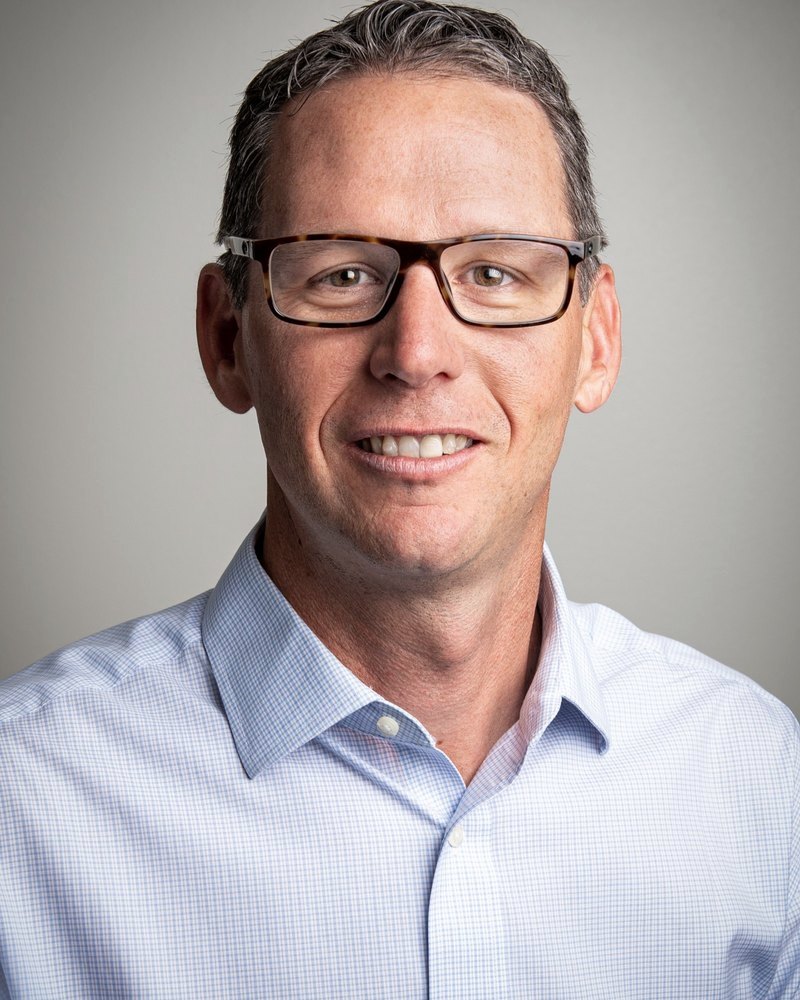
Ask the engineer, who is also an owner. Davis, a general partner in the project and senior vice president at Prosser | PRIME AE, the Jacksonville firm serving as its engineer of record, has watched wave pool projects around Florida get announced and evaporate, and he’ll tell you exactly why they die.
“Typically, the recipe for disaster is announcing too soon,” he says. “I was working on this for a year and a half before anyone knew about it.”
He starts with the land. “We’ve already purchased the land, which is something most of these other parks who say, oh, we’re gonna have a surf park — they never purchase the land… So the things that usually trip those guys up, we’ve already conquered.”
The public record agrees. City Council approved the rezoning 18–0 in February 2025. Aventuur’s local investor group closed on the 45 acres that June for about $21.1 million. The environmental permits — St. Johns River Water Management District, Florida DEP — are in place, along with the city’s site approvals. “We theoretically could go break ground whenever we wanted to,” Davis says of the site approvals. What remains is buttoning up the final design of the lagoon itself and taking it through the city building permit, which the team decided to finish before mobilizing rather than after. “We see we’re still breaking ground this year,” he says. “We’re still targeting 2028 as the grand opening to the community.”
He is 50, and he would like it understood that the schedule is personal. “I wish I could say it was 2027,” he says. “I want to surf now.”
Jacksonville isn’t the only Florida city waiting on a wave. The project furthest along is The Point Surf Park in Fellsmere, near Sebastian Inlet, which broke ground in May 2025 on a 10.5-acre site built around an Endless Surf lagoon. It was aiming to open in September 2026, missed that window, and as of September was expected to open in January 2027, with its reported cost up from $30 million to more than $40 million. Near Tampa, Peak Surf Park, a Surf Lakes project in Pasco County first floated about four years ago, was still working through county approvals in summer 2026. Jacksonville’s would be Aventuur’s first park in the United States. It probably won’t be Florida’s first wave pool.
One Promise
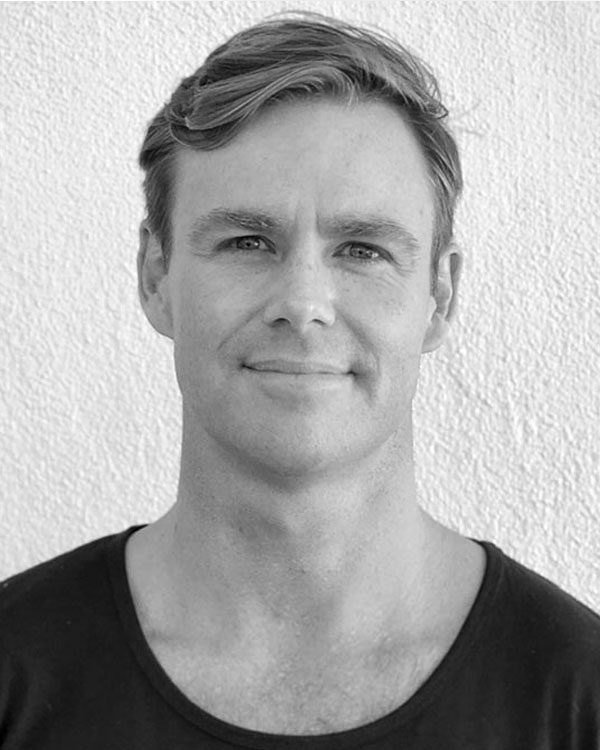
Edelman, Aventuur’s co-founder and CEO, remembers the moment a Jacksonville Board Riders member cut through his presentation to the club with a single request: “You’ve just got to make me one promise, Nick, that you bring the best wave in the whole of the US to Jacksonville.”
Edelman describes the ask with a phone analogy: “The iPhone 6 has come out, there’s now the iPhone 8, and the local guys were just saying, if the iPhone 10’s available, please give us the iPhone 10.”
Aventuur’s answer is a 62-module Cove, up from the 56 modules in the original plans — more than Virginia Beach’s 46 or Palm Desert’s 52, and matching the world’s largest Wavegarden, at São Paulo’s Beyond The Club, where the wave menu includes a double-section wave, an alley-oop section and barrel-to-air combinations.
But what is a module? Davis explains it the way an engineer who surfs explains things. Picture a baseball field. Home plate is the narrow end; the pool widens toward the outfield. Down the center runs a wide concrete wall called the plinth, and mounted along it are the modules — each one driving a large paddle. The paddles fire in sequence, each return stroke feeding the next, and the displaced water stands up and breaks over a concrete bottom the designers call the reef.
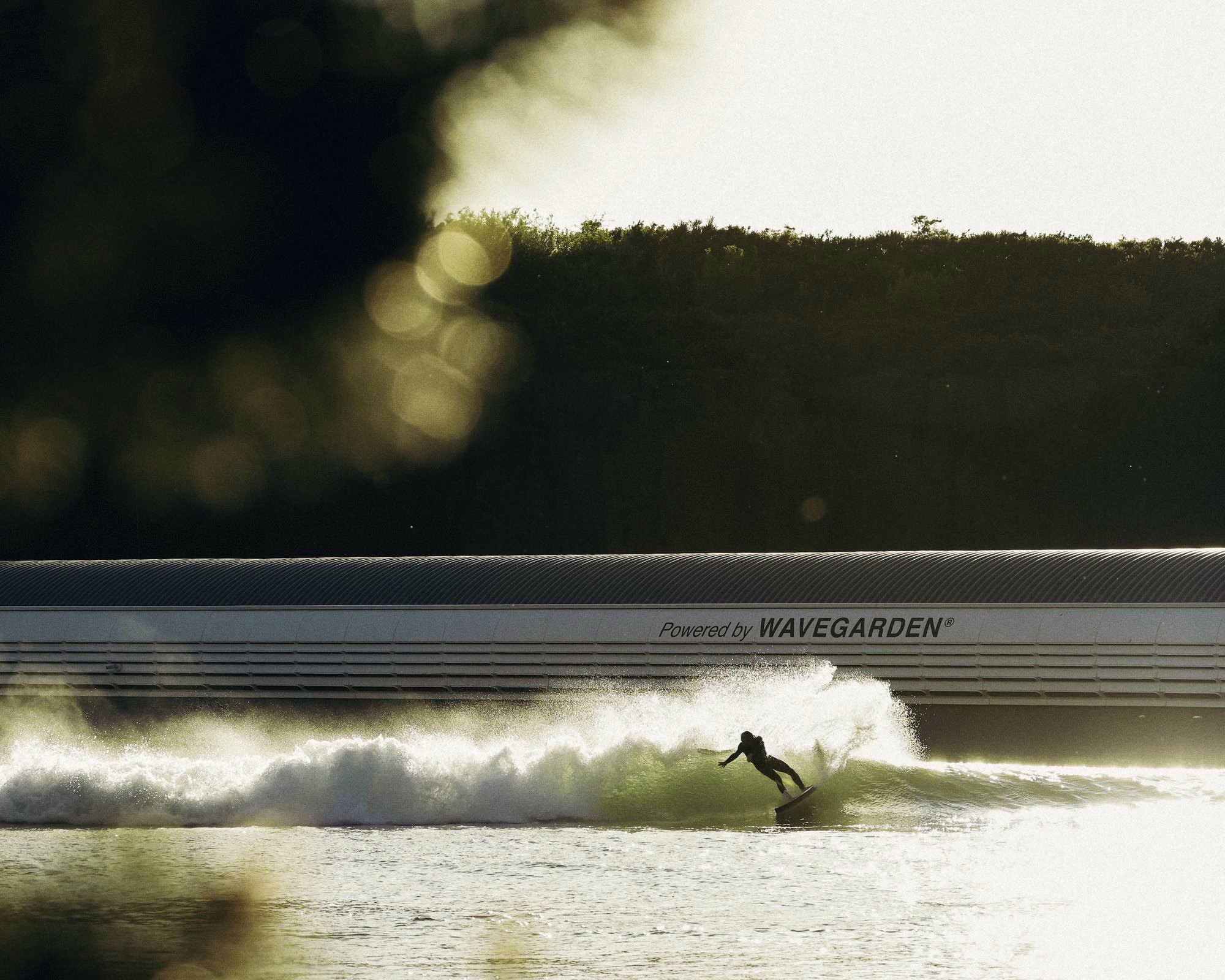
In practice, Davis says, the pool throws sets: four rights and four lefts, about 90 seconds apart, then a reset. At Virginia Beach’s pool, with eight people in the water, Davis was catching 15 to 18 waves an hour. “And I was dying,” he says. “My shoulders were killing me.”
What that feels like under your feet is a question for the one person in this story who spent 16 years riding the best ocean waves on earth. Adrian “Ace” Buchan, Aventuur’s director of surf and sustainability, wrote in responses provided through the company: “It’s hard to compare man made waves to the Ocean as they are completely different in how they are generated. The feeling of surfing is the same but the way the water moves under your feet and the short interval between waves and the compact environment feels completely different. For me, the highlight of surfing in a Cove is always the relaxed atmosphere — everyone gets the same opportunities, there’s no competition for waves and that creates a really supportive environment.”
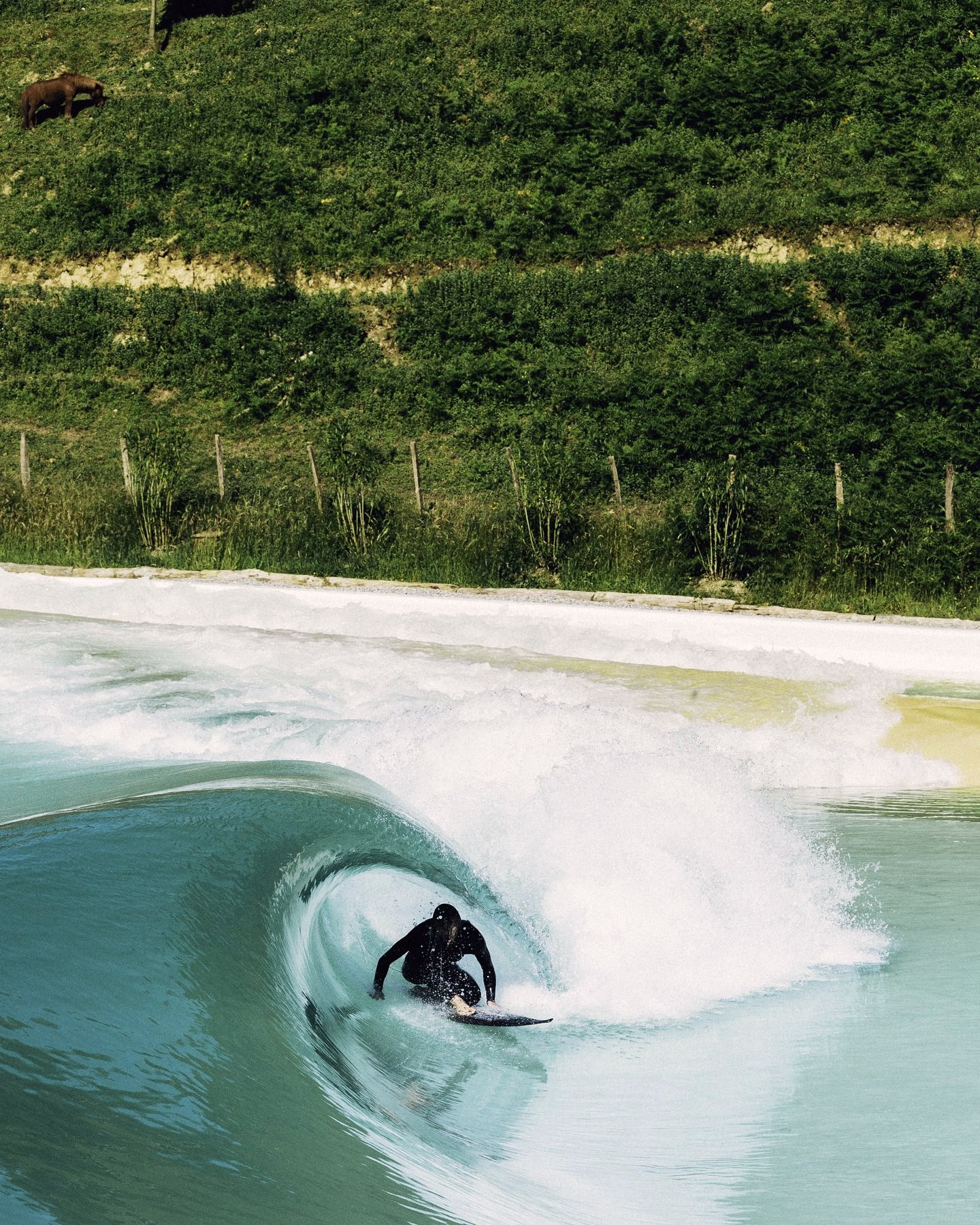
That matches the promise Edelman makes about the lineup itself, and it comes with a number. Each surfer will get 15 waves per session, Aventuur confirmed, so nobody has to fight for position. “There’s abundance, not scarcity,” Edelman says, “so people actually talk in the lineup a lot more in the surf parks.”
“Everyone gets the same opportunities, there’s no competition for waves and that creates a really supportive environment.”— Ace Buchan
The Water Under the Water
Here is the part of the story nobody puts in a rendering.
“Most surf parks in the world are very specifically sited in geographic locations where the groundwater is very low,” Davis says — so low it never comes near the bottom of the lagoon. North Florida is the opposite. Anyone who has dug a fence post here knows the water is right there, and a 5.5-acre concrete lagoon is a very large thing to float in wet ground.
The eTown site is actually the good news version. “Our groundwater separation was about 4 to 6 feet, which is like a mountain for North Florida,” Davis says. The team knew about it before the purchase — the land came with years of data — and knew engineering would be required. What they didn’t know was the price. “When our local partner on the construction side started pricing it, we were like, well, this is not good. This is not good at all.”
That pricing shock is the event behind a line item most readers saw in the news. In September 2025, Aventuur told the city that geotechnical studies had pushed construction cost projections up more than 20 percent. Its engineers put the extra cost at $20 million to $30 million on top of the $110 million originally estimated for the 45-acre development, the Jacksonville Daily Record reported. City Council voted 17–0 to back the project with a property tax incentive worth up to $4.6 million over 10 years. Aventuur says it and its local partners are committing more than $100 million in private investment to the park.
The engineering answer took months and a room full of experts — Davis’s firm, local geotechnical firm ECS, Wavegarden’s engineers in Spain, specialists from Australia. Raise the whole pool 10 feet above the groundwater? That would have hidden it, Davis says: “We’d have no visibility from eTown Parkway... we want the public to see in here, to get excited.” Concrete floors on helical piles? Far too expensive, he says. The solution, one Davis’s firm had used before at Topgolf: a dewatering system beneath the lagoon floor — a branching network of perforated pipes wrapped in gravel, “almost like a Christmas tree under the lagoon bottom,” collecting the groundwater and draining it to a pump station that holds the level exactly where the engineers want it, permanently.
“The groundwater is certainly the single largest challenge that we face in developing a lagoon in North Florida, far and away.”— Brad Davis
It has a solution now, with drawings.
The Water in the Pool
The other question every surfer asks — where does the water come from — has an unusually careful answer, according to Davis, worked out with JEA, the city-owned utility, which he says guards its consumptive use permit “with their life.”
The lagoon gets filled once, from the city’s potable system through a metered fire hydrant connection. After that it’s a closed circuit: by design, water leaves only by evaporation. The top-off water comes not from JEA but from an on-site well permitted through the Department of Environmental Protection, treated through the filtration system before it ever reaches the pool, on a float valve like a backyard pool’s — level drops, well water is drawn and treated, valve closes.
How much? Across Wavegarden’s active lagoons worldwide, Davis says, the annual makeup water works out to roughly what it takes to irrigate three holes of golf. Not eighteen — three.
As for that impossible blue in every Wavegarden clip: the pool paint is white, the blue is depth, and the filtration system, he says, is built to exceed both European and U.S. standards.
Built for Here
A wave pool designed in Spain still has to live in North Florida, and the local partners — “we’ve lived here our whole lives,” Davis says — pushed the design accordingly.
Davis walks through it, hurricanes first. In a tropical event the park closes and everything not anchored goes inside. Ahead of a big rain event, the team can make a call unique to this kind of surf spot: lower the pool in advance, let the lagoon take the storm, treat the water and return to level. The wave changes with depth — “that barrel gets pretty nasty if it gets too shallow” — so it’s a real decision, made with Wavegarden watching the park’s systems in real time from Spain.
Afternoon lightning means lifeguards clear the pool. For summer, the local partners pushed hard on shade: pergolas, canopies, misters and buildings angled to catch the easterly breeze.
Then there’s the terrain — which eTown doesn’t have, so the designers made some. The site is intentionally terraced: at the ticket booth you stand three and a half to four feet above the pool’s coping, and the ground steps down toward the water. It separates spaces and gives everyone sightlines — and it’s the Poles trip, translated into grading plans. “When you walk from the parking lot to when you see that first wave,” Davis says, “we’re going to do the very best we can, through landscape and hardscape, to give you that same feeling.”
More Than a Pool
The wave will eventually be commoditized — anyone can license a Cove. What Aventuur is betting on is everything around it, and Edelman has no shortage of ideas. A session could be designed like a playlist, warm-up waves into turns into barrels. “You come down and you do the First Coast session,” he says. He also floated a “Big Day Out,” where you book the whole day instead of an hour, towels on the grass, one-in-one-out like a beach day, plus twin-fin nights, shaper demos, movie screenings and speaker nights. None of it is a formal plan yet.
The park is built to be watched, not just surfed. The design gives the surrounding green space sightlines into the lagoon from outside the paywall, deliberately — concerts, movie premieres, an Eastern Surfing Association contest or a Board Riders night with the lawns full. Capacity for a big event, Davis suspects, will be limited less by the shoreline than by parking.
The clubhouse spirit comes with rules already forming. Molly Picklum, the Australian Championship Tour surfer, is an investor in the park, Edelman says, and she has proposed that before every session, everyone in the water fist-bumps everyone else. Because everyone gets out at the same time, Edelman wants the session to end the way it never can in the ocean: together, over a coffee or a beer, wave replays on the screen. The park will capture video for guests, Aventuur says, and surfers will be able to view and download footage of their waves.
“We really want this to be a third place for surfers.”— Nicholas Edelman
Access, Edelman says, will run from roughly $30 beginner-bay sessions to top-tier waves under $100 depending on day and time — against what he puts at $80,000 for a private day at Surf Ranch — with parts of the park free to enter and a block of “charitable hours” donated to people in need. He calls it passing on the gift of surfing.
Why Here
Aventuur holds exclusive U.S. rights to Wavegarden technology in eight markets: Dallas, Austin, Nashville, Atlanta, Las Vegas, Denver, Phoenix and Jacksonville. By Edelman’s account, Texas was supposed to come first.
Jacksonville jumped the line. Edelman, who grew up on coastal culture near Bondi Beach, says the city “jumped off the page”: the surfer population, World Surf League viewership among the highest in the country, the climate, the depth of the culture. He credits Lockwood Holmes, from a fifth-generation Jacksonville family, with making the case. “He convinced us to come to Jacksonville, which we’re very thankful for,” Edelman says.
The local half of the story starts, improbably, at Typhoon Lagoon around 2009, when Davis invited 10 or 12 clients to skip the last day of an Orlando real estate convention and go surf the Disney pool. “The stoke on these people’s faces was so authentic and so much fun that I looked at my business partner and said, we’re on to something,” he says. His firm swore off the standard corporate outing on the spot. “Everybody else can go play golf. They can have it. Not us.”
The client trips became a study program. Waco taught him what a park with no amenities feels like. Kelly Slater’s Surf Ranch had “the best wave in the world,” he says, but one surfer at a time and a pressure that froze his clients solid; what he took from it was the service, “like you’re at the Ritz-Carlton, but at the surf park.”
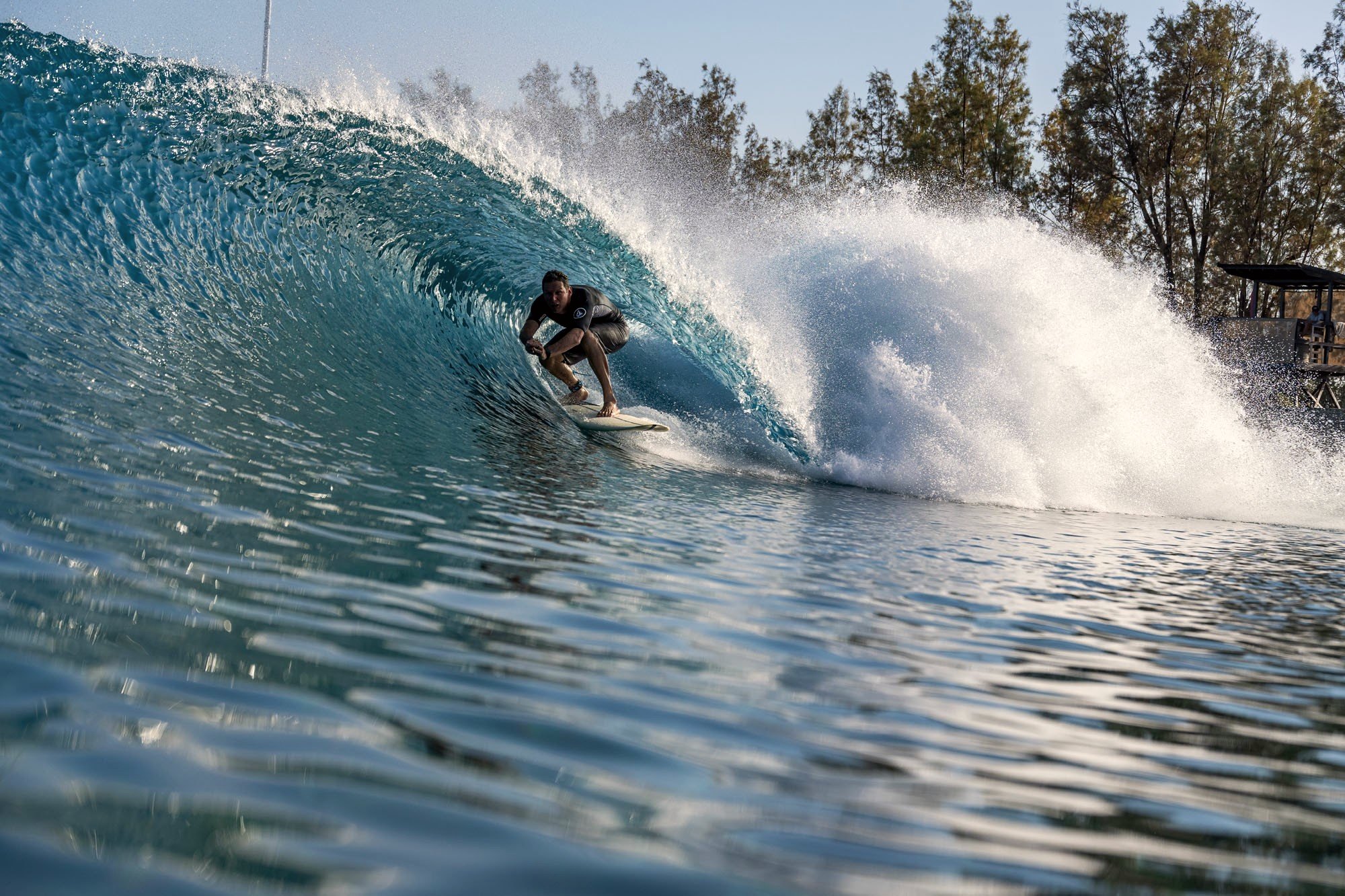
He is generous about all of them, on principle. “You won’t hear anyone from Aventuur or from any of the partners say anything negative about another surf pool, because the way we see it is a rising tide floats all ships.”
Aventuur commissioned a formal siting study for North Florida, Davis says. St. Johns County had cheaper land but was farther from the surfers. Downtown, which Davis liked, “is riddled with contamination issues,” a hard problem for a giant pool. When eTown came up — St. Johns to the south, Duval and Clay wrapped around it, the airport, the beach, shopping all close — “it was like X marks the spot.”
And since the land was bought from an entity associated with Jacksonville’s Davis family: no relation. “I’m on the other side of the tracks,” he laughs.
Not Competing With the Ocean
Ask Edelman whether wave parks replace the ocean and he shuts it down before the question finishes.
“The surf parks should be in complement to the ocean, never in competition. Mother Nature’s always number one.”— Nicholas Edelman
The park’s case is the days the ocean doesn’t show: flat spells, summer, the weeks when the only window is 7 p.m. on a Tuesday.
What the pool adds is a wave matched to the surfer. Edelman explains it with a ski analogy — the ocean sends whatever it sends, black diamond or bunny slope, but the pool can hand a beginner “a nice, gentle, Waikiki one-foot rolling wave,” build to a Malibu-style roller, then performance walls, then barrels. The operators set that menu, not the surfers: Aventuur says a session can run a programmed mix of wave types, but surfers can’t choose their own waves on demand.
For First Coast surfers raised on shifting beachbreak peaks, Buchan — who was in the water at the Poles that blessed day — wrote that they start with an advantage. “Ocean skills generally translate really well to the Cove. Having all those instincts and quick reflexes of surfing beach breaks is very helpful.” Because Jacksonville’s Cove will be larger, he wrote, the rides will be longer, and the range of waves it can make for different tastes and skill levels is “something I am really excited about.”
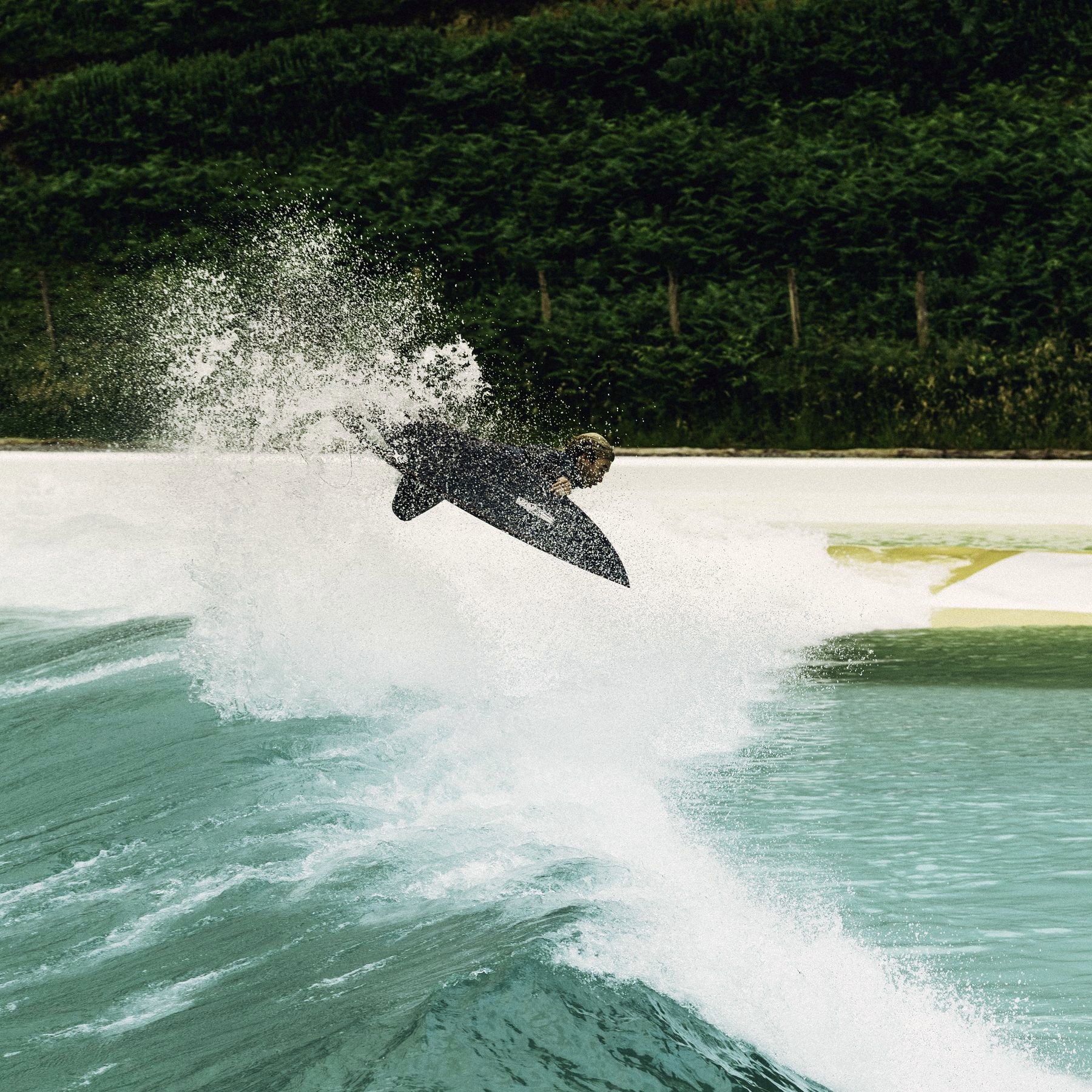
At the far end of the pathway are the First Coast’s competitive surfers. Edelman brings up Lanea Mons unprompted — practicing airs, running backhand barrel repetitions with a coach — the kind of training that today means a plane ticket to California.
Ty Miller, a Jacksonville surf parent, knows what that costs a family. His daughter, Skylar, is 13, and in October at Wavemasters she finished third in the open women’s division as its youngest competitor. The Millers have surfed that contest for the better part of 30 years: first Ty’s father, then Ty, now Skylar. They are Jacksonville Board Riders members. “We have been as a family since the beginning,” he says.
Asked what a pool would change, he gets it down to one word. “If I had to boil it all down to like one word is consistency,” he says. “So you have the ability to consistently stay moving and stay surfing, whether that’s the younger surfer who’s in a flat spell that needs to keep moving or the older guy that like any sport, the longer you stay still, the tighter you get, the worse you get.”
For now, a flat spell means a road trip. Local surfers drive to New Smyrna Beach or Ponce Inlet, which pick up small swell better than Jacksonville does, or farther when winter swells hit South Florida. Miller puts a day trip at $100 to $200 in gas and food, and figures a couple of hours in the pool would cost about the same. “I 100% could see us taking advantage of having the pool here versus feeling the need to go to a crowded New Smyrna on Saturday to get a few waves,” he says.
“I think those kind of stadium pressure cooker under the lights type events will be huge for us.”— Ty Miller
The View From the Club
Among the surfers and parents FCL spoke with, nobody opposed the park; the doubts were about the promises and the price.
For Miller, price is what will decide it: keep it aggressive, he says, and the business will come. He points to a desert park out West that set prices high, drew a backlash and lowered them, and his own guess for Jacksonville sits in the middle of Aventuur’s range: “I would guess that we probably see sessions come around 60 to 80 a session, based on the type of wave and time that you’re trying to be there.”
He doesn’t recall the “one promise” request at the Board Riders meeting, and the best-wave claim gives him pause. “I think that’s probably a pretty hard claim,” he says. “You’re going to find that some people have enjoyed Waco more than they have Virginia and then vice versa.” Making the claim, he adds, “is a tough one to make.”
He also reads meetings like that one plainly. A new kind of project needs investors, and a surf club full of accomplished people is a good place to build buzz. “If you break it down into X’s and O’s, it’s coming down to dollars,” he says.
None of that dampens the club’s mood, by his account. Everybody he knows there is excited, he says, and while a pool “will never replace the ocean,” it is an asset, most of all for competitive surfers. He sees contest nights at the lagoon, with families finally able to watch. “I think those kind of stadium pressure cooker under the lights type events will be huge for us.”
Even the environmental question, the one he hears most from critics, comes out on the park’s side for him. “I’m a hunter. I’m a surfer. I consider myself somebody who likes to preserve and protect nature,” he says. Weighed against what the park would give young surfers, in fitness, competition and plain experience, he doesn’t think the cost outweighs it.
The national Surfrider Foundation, the largest surf advocacy organization in the country, has no formal policy on inland wave pools. In a position statement on its website, the organization says it monitors the growing interest in wave pools and their environmental effects — land use, energy consumption, water use and waste — but does not oppose them categorically. It would engage, the statement says, if a proposed park threatened the coastal environment. The Jacksonville project is inland, about 10 miles from the ocean.
Zack Stalnaker, also a Jacksonville Board Riders member, has a more personal stake: his family is already on the list for the first waves. His daughter, Romie, 15, has volunteered at the Super Girl Surf Pro for the past several years, after taking part in Rising Tides, a program within the event, and she won Aventuur’s Inspiring Star Award, which comes with a place among the park’s first surfers for her and her immediate family. Nobody told her ahead of time. “We made sure we were there at the awards ceremony and when they called her up and told her about the wave pool she was super surprised and stoked,” he says. He was too, since the prize covers the family. “Strange people are trying to claim they are related to me,” he says.
The Stalnakers are, in his words, “Jax beach rats,” and the Pier and the Poles are home. But contests and free surfing have taken them from California to Puerto Rico and, a couple of times, Atlantic Park, the Wavegarden in Virginia Beach. He pictures using Jacksonville’s pool the way he’d use a home break: “imagine wanting to go there a lot when the waves are flat, or just to have a perfect wave to practice specific techniques on.”
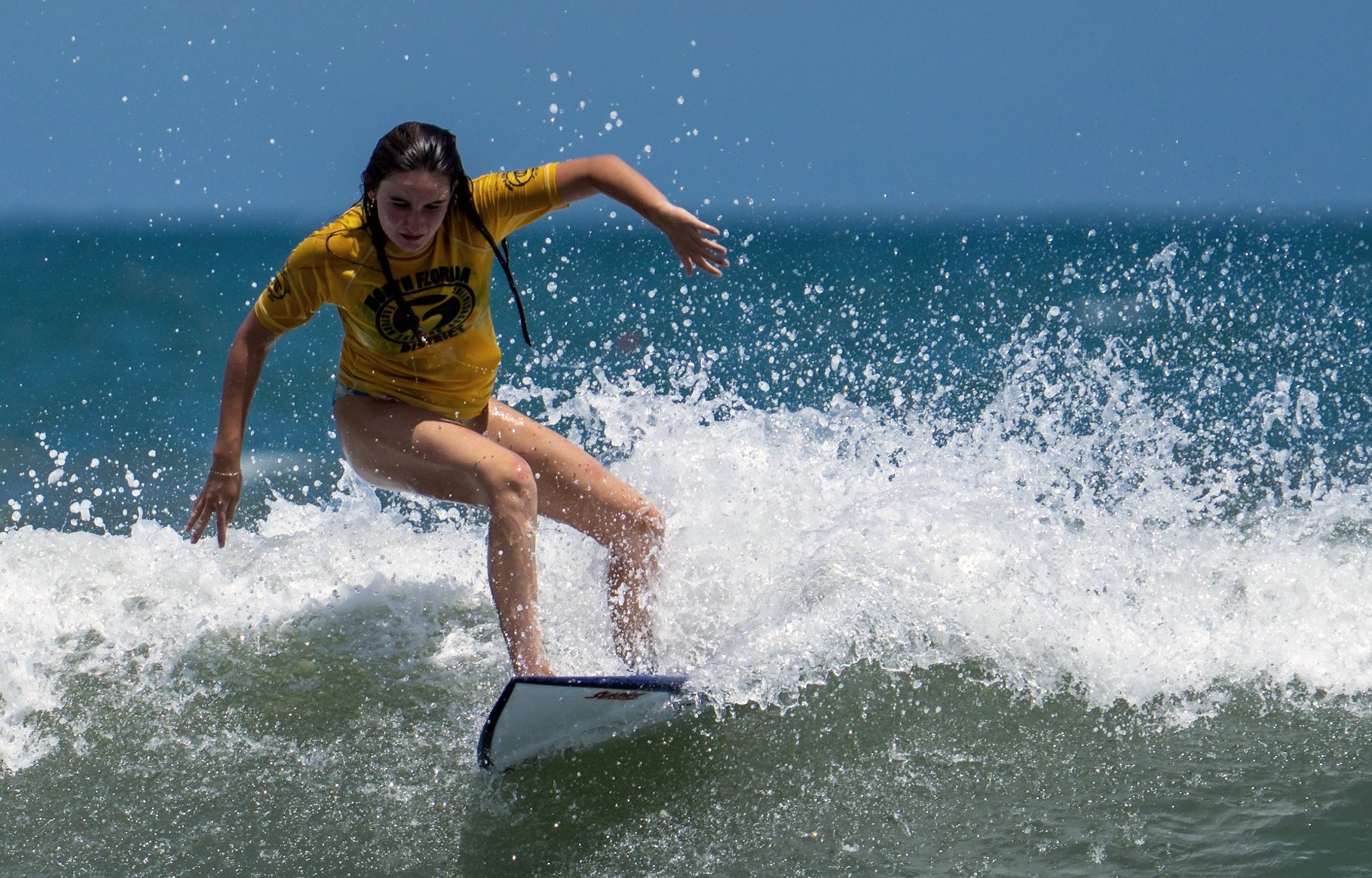
Like Miller, he hears only good things around the club. “You can’t always make everyone happy, plus we have a super competitive community… we love each other, but we all like to compete,” he says. He wasn’t at the meeting for the one-promise request either, and he keeps his answer simple.
“I will be grateful for whatever wave they give us, and I bet it’s gonna be good!”— Zack Stalnaker
The Honest Part
Edelman doesn’t oversell it. He recalls being asked at a community meeting whether he could guarantee the park would be delivered. “You can’t promise anything in terms of that,” he says. “All I can say, hand on heart, is we are doing our absolute best to bring this asset, and we think we’re in a great position to do that.”
What’s left is a short list: finish the lagoon design, pull the building permit, break ground. The permit is the next public marker to watch; the team wants it in hand before crews mobilize.
When we spoke, Davis had a First Coast problem to solve. Bow-hunting season had just opened. There was a flood tide for fishing. And the Poles, for once, had waves. “I’ve got big decisions between now and tomorrow,” he said.
If the schedule holds, two years from now one of those decisions gets easier: the waves will be there whenever he shows up.
Editor’s note: First Coast Lineup will follow the project through groundbreaking.
How this story was reported: Nicholas Edelman was interviewed by video call on Aug. 14, 2026, and Brad Davis on Sept. 25, 2026, both with Aventuur’s public relations firm, Quinn PR, present. Their quotes come from transcripts of those calls provided by Quinn PR. Ace Buchan answered FCL’s questions in writing through Quinn PR; his words are quoted as written. Ty Miller was interviewed by phone, independently of Aventuur and Quinn PR, and his quotes come from FCL’s recording of that call. Zack Stalnaker answered FCL’s questions in writing, also independently of Aventuur and Quinn PR; his words are quoted as written. His daughter’s award, which includes early access to the park for her family, was given by Aventuur. Before publication, Aventuur reviewed a list of its quotes and facts for accuracy; it did not see the story. FCL contacted the Surfrider Foundation First Coast chapter for its position on the Jacksonville project; the chapter did not respond by publication. The national Surfrider Foundation position on wave pools is drawn from its website. Permits, land and tax-incentive details come from the public record.
Brad Davis is a general partner in the Jacksonville Surf Park and a senior vice president at Prosser | PRIME AE, the project’s engineer of record. No interview subject was offered copy approval. First Coast Lineup carries no advertising, and no sponsor has a say in its coverage.